
We help global ERP programs succeed in Brazil
Because Brazil's tax complexity — NF-e, SPED, and a regulatory environment that changes every year — cannot be solved by a global template alone.
Most organisations treat Brazil as a configuration problem. It isn't.
The decisions that determine whether your go-live is clean — chart of accounts, fiscal document flows, tax classification — are architectural decisions.
Make them wrong, and no amount of configuration fixes them after the fact.
We work alongside your programme team as independent specialists, with no implementation quota and no software to sell
Whether you are planning a Brazil D365 rollout, navigating go-live challenges, or dealing with NF-e and SPED complexity, we can help.


We help global ERP programs succeed in Brazil
Because Brazil's tax complexity — NF-e, SPED, and a regulatory environment that changes every year — cannot be solved by a global template alone.
Most organisations treat Brazil as a configuration problem. It isn't.
The decisions that determine whether your go-live is clean — chart of accounts, fiscal document flows, tax classification — are architectural decisions.
Make them wrong, and no amount of configuration fixes them after the fact.
We work alongside your programme team as independent specialists, with no implementation quota and no software to sell
Whether you are planning a Brazil D365 rollout, navigating go-live challenges, or dealing with NF-e and SPED complexity, we can help.
Before You Start Your
ERP Implementation in Brazil
Most organisations implementing D365 in Brazil discover the Brazil-specific complexity after the global design is locked in. The architecture decisions that determine your compliance exposure, your go-live readiness, and your long-term operational cost are made in the first few months, often before the right questions have been asked.
We help organisations ask the right questions before those decisions are irreversible:
Whether your go-live timeline accounts for multiple fiscal document testing scenarios
How your global template will interact with Brazil's NF-e and SPED requirements
How intercompany, import, and sales flows should be structured
How tax setup decisions today will affect operations after go-live
Trade-offs between compliance, complexity, and scalability
Already mid-implementation or post go-live? The same decisions apply, and there is still time to get them right before they become permanent.
Decisions made at this stage define the complexity, cost, and risk of the entire ERP program.
20+
Years at the intersection of Brazilian tax regulation and D365 architecture
Where We Add Value
Organizations typically engage us in three situations:
Before Implementation Starts
— You are evaluating how to structure your Brazil operations within a global ERP program.
— Miss them and you are fixing Brazil-specific architecture gaps under go-live pressure, at two or three times the cost of addressing them at the start.
During Implementation
— Configuration efforts are not resolving the underlying issues.
— Global templates are not working locally.
— Tax, accounting, and operations are misaligned.
— The program is at risk.
— You are not sure whether the challenge sits in the configuration, the solution design, or the Brazil-specific requirements — and the answers are not yet clear.
The earlier we engage, the lower the risk — and the cost
— The system is live, but specific areas are not delivering what was expected.
— Fiscal documents are failing. Tax outputs are incorrect. Local operations are not running as designed.
— This is rarely a configuration issue. It is almost always a sign that the Brazil-specific fiscal architecture was not fully addressed during the original design.
After Go-Live
01
We help you define the right approach before build begins.
We come in to identify what is wrong and correct the solution, without restarting the programme.
02
We assess what was built, identify the root cause, and fix the architecture, independently of who implemented it.
03
Our Role
We operate as independent ERP transformation architecture advisors for organizations implementing Microsoft Dynamics 365 Finance in Brazil.

We are not a configuration team.
Brazil does not introduce complexity. It surfaces the gaps between global ERP design and what Brazilian fiscal requirements actually demand. Our role is to identify those gaps before they surface at go-live, in an audit, or when the programme needs an independent architectural perspective.

We work independently.
We have no implementation quota to fill and no software to sell. We do not replace implementation teams, we provide the architectural clarity that enables them to succeed.

We bridge the gap.
In Brazil, a tax decision is also an operations decision. A finance configuration is also a supply chain constraint. When these are designed in isolation — by different teams, in different workstreams — the gaps between them become the problems that appear after go-live. We design across all three from the start.
When the design is right, everything else follows.
01
02
03
What Global ERP Programs Get Wrong in Brazil
Lessons from real ERP environments, on process architecture, cross-functional design, and the fiscal complexity that most global templates do not anticipate.
When ERP Programs Need Architecture Guidance Beyond Implementation
The moment a programme team realises the issue is not in the settings — it's in how the solution was designed for Brazil. What that looks like and what to do about it.
A standard consignment model that worked in five countries failed in Brazil because of how NF-e handles ownership transfer. The architectural decision that resolved it.
How recurring NF-e and costing inconsistencies pointed to a process architecture gap, not a configuration problem.
When Your Consignment Model Works Everywhere Except Brazil
When an Intercompany Issue Is Actually a Cross-Functional Process Design Problem
If your organization is facing similar challenges in your D365 Finance program in Brazil, we'd be glad to have a conversation.
FIELD INSIGHTS


Make Your D365 Rollout Ready for Brazil
Readiness Isn’t a Step — It’s the Strategy Behind Every Successful Rollout
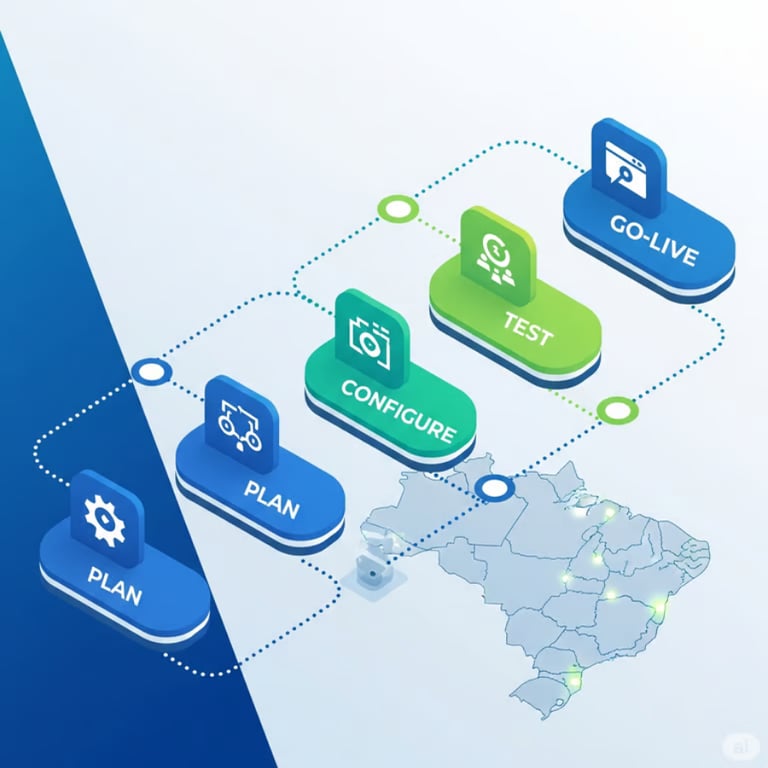
Rolling out Dynamics 365 Finance & Operations in Brazil is unlike any other market — where tax, compliance, and real-time reporting reshape how global templates work.
That’s why ASDM developed the READY Framework — a structured approach that helps international teams plan, design, and deploy D365 projects that are fully compliant from day one.
Built from 25+ years of hands-on experience with global ERP programs, READY helps you:
Anticipate Brazil’s tax and legal complexities before build starts.
Align global and local teams around a clear rollout plan.
Validate compliance and tax logic early — before go-live.
Prevent costly redesigns, rework, and compliance delays.
The result? A rollout that’s not just compliant — it’s coordinated, predictable, and audit-ready.
Learn how the READY Framework helps global ERP teams succeed in Brazil.
Ready to get your Brazil programme architecturally right?
Follow us
© 2026. All rights reserved.