

When Your Consignment Model Works Everywhere Except Brazil
A consignment model that worked in five countries created unexpected complexity in Brazil. The reason was not configuration — it was how NF-e handles ownership transfer.
ASDM Solution
5/5/20263 min read
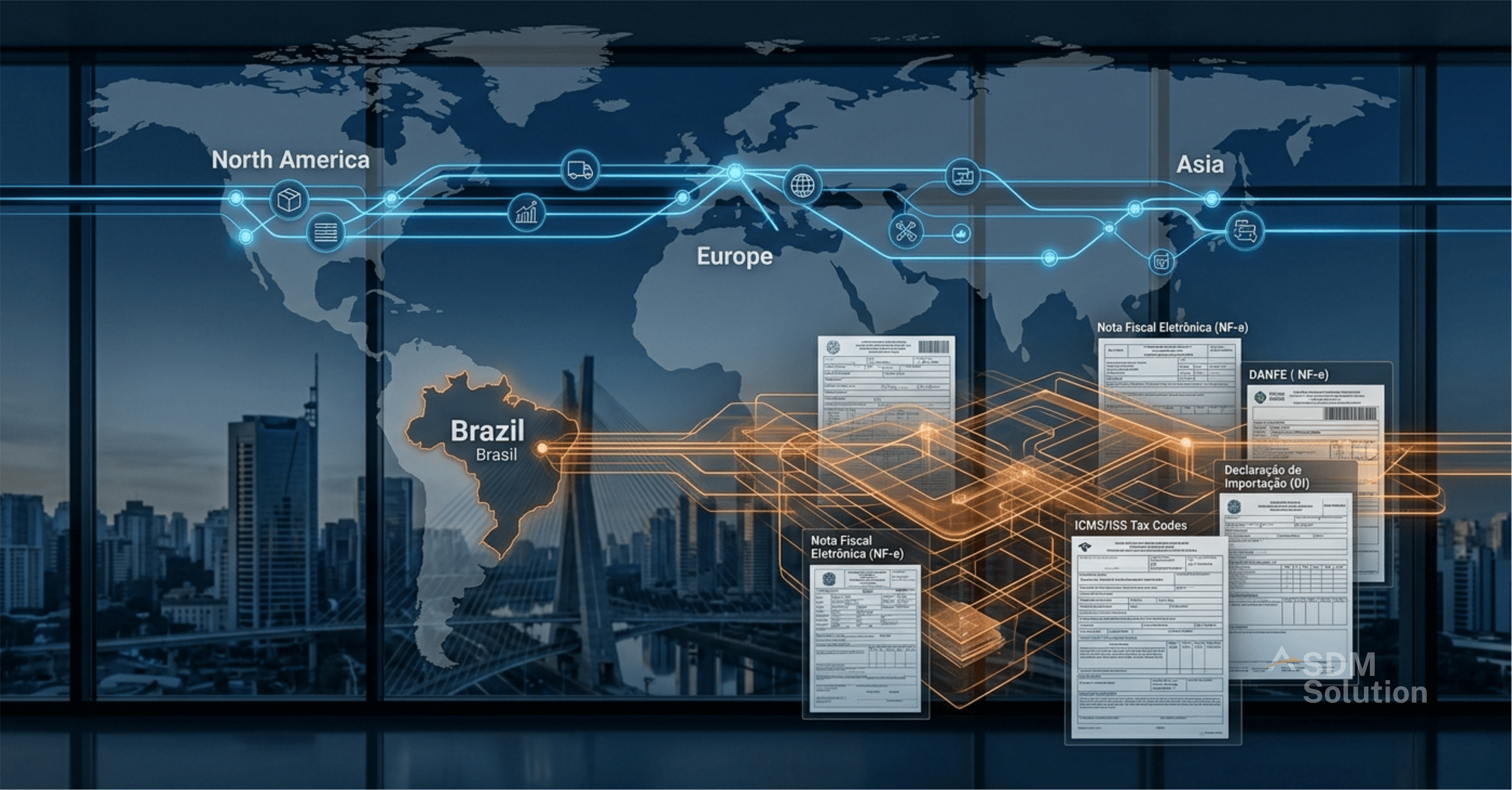
Why Global Consignment Models Require a Different Approach in Brazil
Consignment inventory is a well-established operating model in global supply chains.
In most markets, the process is predictable: inventory moves to a customer warehouse, ownership stays with the supplier until consumption, and the ERP system tracks the movement through transfer orders and warehouse management processes.
It works reliably. It has been tested across multiple legal entities. The global template handles it well.
Then the programme extends to Brazil — and what looked like a straightforward configuration becomes something else entirely.
What Brazil Adds to the Consignment Process
In most markets, consignment is primarily a logistics and inventory question.
In Brazil, it is also a fiscal transaction question.
Brazil's regulatory environment requires that a consignment operation support a structured exchange of fiscal documents between supplier and customer at defined stages of the process. Different tax calculations apply depending on where goods are in the consignment cycle. Specific regulatory obligations govern both the movement and the ownership of goods at each stage.
The process is no longer a warehouse transaction.
It becomes a sequence of operational and fiscal events that must remain synchronised between both parties — at every step, with every movement, and with every document exchange.
This is not a gap in the global template.
It is a gap that Brazil's fiscal architecture creates against a template that was designed for markets where consignment does not carry these obligations.
The Situation
A global organisation wanted to extend its existing consignment model to Brazil.
The process was already operating successfully in multiple legal entities using the organisation's global supply chain template. The expectation was reasonable: if it works in five countries, it should work in Brazil with the same approach.
When the team began evaluating the Brazil implementation, it became clear that the global configuration could not be applied directly.
The fiscal document requirements that Brazil introduces at each stage of the consignment cycle — the exchange of NF-e documents, the tax calculations that change based on the stage of the operation, the regulatory requirements around ownership transfer — are not supported by a standard consignment flow.
What began as a configuration activity became a process design exercise.
Why Cross-Functional Alignment Was Required
Designing a workable solution required coordination across several areas of the organisation simultaneously.
The global supply chain process lead needed to preserve the integrity of the global operating model. The Brazil commercial team had requirements around how the customer relationship and operational flexibility should be maintained. Logistics teams were responsible for the physical movement and control of goods. Finance and accounting needed the financial transactions to align with corporate reporting structures. Tax specialists were responsible for ensuring full compliance with Brazil's fiscal regulations.
Each group had legitimate requirements.
Each group's requirements touched the consignment process from a different angle.
The solution could not be designed from any single functional perspective — not from supply chain alone, not from tax alone, not from finance alone.
It required aligning all of them into a single end-to-end process that satisfied Brazil's fiscal architecture without fragmenting the global operating model.
What the Process Design Involved
Working with global and local stakeholders, the team reviewed the complete transaction flow:
How goods moved between supplier and customer at each stage of the consignment cycle. How fiscal documents were generated and exchanged — and at which point in the process each document applied. How tax calculations were determined based on the current stage of the operation. How inventory quantities and ownership were tracked and controlled throughout.
Because the process involves multiple fiscal documents and inventory movements across an extended timeline, additional control mechanisms were also required — monitoring the flow of consignment invoices, quantities held in customer warehouses, and the relationship between fiscal documents and inventory balances at any given point.
These controls were not optional.
They were essential to maintaining both operational visibility and regulatory compliance.
The Outcome
By designing the process around Brazil's fiscal architecture — rather than attempting to apply the global configuration directly — the organisation implemented a consignment model that worked correctly in Brazil while remaining aligned with the global supply chain design.
The ERP system could then support the process in a consistent and controlled way.
No manual workarounds. No compliance gaps. No fragmentation of the global model.
Final Insight
Global ERP templates are built to handle consignment effectively.
Brazil creates specific requirements around fiscal documents and ownership transfer that most global templates were not designed to address — because no other market requires them in the same way.
When organisations approach this situation from a process design perspective — rather than a configuration perspective — they can build a solution that works correctly in Brazil without compromising the integrity of their global ERP model.
The earlier that evaluation happens in the programme lifecycle, the lower the cost of getting it right.
ASDM Solution operates as an independent ERP transformation architecture advisory practice, focused exclusively on Dynamics 365 Finance programmes in Brazil.
If your organisation is planning to extend its supply chain operations to Brazil — or is already mid-implementation and encountering unexpected complexity — we'd be glad to have a conversation.
Ready to get your Brazil programme architecturally right?
Follow us
© 2026. All rights reserved.